
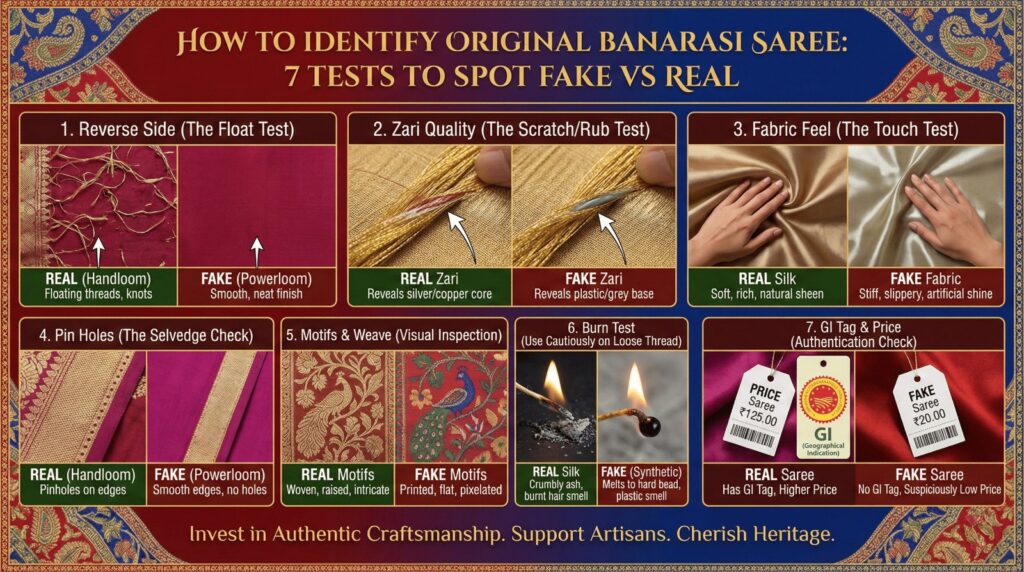
How to Identify Original Banarasi Saree: 7 Tests to Spot Fake vs Real
Introduction to Banarasi Sarees
The Heritage and Legacy of Banarasi Sarees
Have you ever draped yourself in a saree that feels like pure luxury? That’s the magic of an authentic Banarasi saree. Originating from the ancient city of Varanasi, these sarees have been the crown jewel of Indian textile heritage for over 400 years. Woven with intricate patterns inspired by Mughal art, each Banarasi saree tells a story of tradition, craftsmanship, and timeless elegance.
These sarees aren’t just pieces of cloth; they’re wearable art passed down through generations of skilled weavers. From royal weddings to special celebrations, a genuine Banarasi saree has always been a symbol of grace and sophistication. But here’s the catch—with such prestige comes the unfortunate reality of counterfeits flooding the market.
Why Authenticity Matters
Why should you care whether your Banarasi saree is real or fake? Well, beyond the obvious disappointment of not getting what you paid for, buying fake sarees impacts the livelihoods of traditional weavers who’ve dedicated their lives to this craft. Plus, authentic Banarasi sarees are investments that last generations, while knock-offs fall apart after a few wears. Wouldn’t you rather own something genuine that carries both beauty and cultural significance?
Understanding the Characteristics of Genuine Banarasi Sarees
The Craftsmanship Behind Banarasi Weaving
Creating an authentic Banarasi saree is no walk in the park. It’s a labor-intensive process that can take anywhere from 15 days to six months, depending on the complexity of the design. Master weavers use traditional handlooms, working with immense patience and precision to create the intricate brocade work that Banarasi sarees are famous for.
The weaving technique involves interlacing gold or silver zari threads with silk to create raised patterns that shimmer beautifully. This isn’t something machines can perfectly replicate, despite their attempts. The human touch brings an irregularity that’s actually a mark of authenticity—like a fingerprint unique to handcrafted items.
Materials Used in Authentic Banarasi Sarees
Real Banarasi sarees are woven from pure silk—typically mulberry silk—which gives them their characteristic smooth texture and natural sheen. The zari (metallic thread) used in authentic pieces traditionally contained real gold or silver, though nowadays most use high-quality metallic alloys that still maintain durability and luster.
The contrast is stark when compared to synthetic substitutes. Fake versions often use polyester or art silk combined with plastic-coated threads that masquerade as zari. Can you spot the difference? That’s exactly what we’re here to help you with.
The Growing Problem of Fake Banarasi Sarees
Market Challenges and Consumer Concerns
Walk into any market claiming to sell Banarasi sarees, and you’ll find hundreds of options at wildly varying prices. The problem? Many of these are power-loomed imitations manufactured in other states or even countries, then falsely marketed as authentic Banarasi handloom sarees.
Consumers often fall victim to these frauds because they lack the knowledge to distinguish real from fake. The emotional and financial loss is significant—imagine spending thousands on what you believe is a family heirloom, only to discover it’s a cheap imitation.
Economic Impact on Weavers
The proliferation of fake Banarasi sarees doesn’t just deceive customers; it devastates the artisan community. Traditional weavers in Varanasi struggle to compete with mass-produced counterfeits sold at unrealistically low prices. This economic pressure has forced many skilled artisans to abandon their ancestral craft, putting centuries-old weaving traditions at risk of extinction.
When you choose authentic, you’re not just buying a saree—you’re preserving a heritage and supporting families who’ve kept this art alive.
7 Definitive Tests to Identify Original Banarasi Sarees
Test 1 – The Thread Burn Test
How to Perform the Burn Test
This is perhaps the most definitive test for checking silk authenticity. Here’s how you do it: carefully pull out a few threads from an inconspicuous area of the saree (like the inner seam). Using a lighter or match, carefully burn these threads in a well-ventilated area.
What to Look For
Genuine silk threads will burn slowly with a smell similar to burning hair or feathers—that’s the protein in natural silk. The ash will be dark and crumbly, easily turning to powder when rubbed between fingers. Real zari threads will leave behind a residue of metal after the thread burns away.
Fake silk (polyester or art silk) burns quickly with a chemical smell, melts rather than burns, and leaves behind hard, plastic-like beads. Fake zari simply melts into plastic without any metallic residue. Pretty clear difference, right?
Test 2 – Check the Zari Quality
Real vs Fake Zari
Authentic zari has a rich, warm glow rather than a harsh, shiny appearance. Real metallic threads maintain their luster over time and don’t tarnish easily. When you look closely at genuine zari, you’ll notice it has a slightly textured surface because it’s made by wrapping metallic foil or wire around a silk thread core.
Fake zari, on the other hand, is typically plastic thread with metallic coating. It has an artificial shine that looks cheap under natural light. Over time, this coating peels or fades, revealing the plastic underneath.
The Touch and Feel Test
Run your fingers over the zari work. Does it feel substantial and slightly rough? That’s authentic zari. Fake zari feels smooth, flat, and plasticky. Genuine zari also adds noticeable weight to the saree, while plastic alternatives are surprisingly light.
Test 3 – Examine the Weave Pattern
Handloom vs Power Loom Differences
This test requires a closer look at the saree’s structure. Hold the saree up to light and examine the weave. Handloom Banarasi sarees show slight irregularities in the weave pattern—the threads aren’t perfectly uniform, and you might notice minor variations in tension. This “imperfection” is actually perfection in handcrafted items.
Power-loomed sarees have mechanically perfect, absolutely uniform weaves. The patterns are too precise, too identical, lacking the organic variation that comes from human hands guiding the loom.
Looking for Irregularities
Flip the saree to examine the reverse side. In authentic handloom Banarasi sarees, the back shows loose threads and the pattern is clearly visible (though reversed). The weaving technique creates a “doubleness” where you can see how the design is integrated into the fabric itself.
Machine-made copies often have the pattern printed or embroidered on top of a base fabric, so the reverse side looks completely different or shows glued threads. That’s your red flag.
Test 4 – Verify the Weight
Why Authentic Banarasi Sarees Are Heavier
Ever wondered why your grandmother’s Banarasi saree feels so substantial? Genuine Banarasi sarees are noticeably heavy due to the pure silk fabric and real metallic zari work. Depending on the amount of brocade work, an authentic piece typically weighs between 500 grams to over a kilogram.
This weight is distributed evenly throughout the saree, giving it a luxurious drape that falls gracefully. When you hold it, you can literally feel the quality.
Weight Standards for Different Varieties
Not all Banarasi sarees weigh the same. Plain silk Banarasi sarees with minimal zari work are lighter (around 400-600 grams), while heavily embroidered bridal pieces can exceed 1.5 kilograms. Knowing these ranges helps you gauge whether what you’re holding matches expectations.
If someone’s selling you what they claim is a “pure Banarasi silk saree with heavy zari work” but it feels light as a feather, alarm bells should be ringing.
Test 5 – Inspect the Borders and Pallu
Interlocking vs Attached Borders
Here’s a technical detail that separates the real deal from fakes: borders and pallu attachment. In authentic handloom Banarasi sarees, the borders and pallu are interlocked with the body of the saree during the weaving process itself. This means they’re an integral part of the fabric, woven together thread by thread.
To check this, look closely at the junction where the border meets the body. Can you separate them? In genuine pieces, they’re inseparable without cutting threads. Fake sarees often have separately woven borders that are stitched or glued onto the saree body—you can feel the seam or see the attachment line.
Motif Precision and Detail
Examine the motifs on the pallu and borders. Authentic Banarasi work features intricate designs like floral patterns (kalga and bel), Mughal-inspired motifs, or traditional Indian imagery woven with incredible detail. Each motif has depth and dimension, with the zari creating raised patterns you can actually feel.
Counterfeit versions have flat, poorly executed designs that lack the refinement and intricacy of handwoven work. The patterns might look busy but without the careful execution that characterizes genuine craftsmanship.
Test 6 – Look for the Silk Mark
Understanding Certification
The Silk Mark is an official certification provided by the Silk Mark Organisation of India, authenticating that the fabric contains pure silk. This small label, usually attached to the saree, serves as a government-backed guarantee of quality.
However—and this is important—the Silk Mark only certifies the silk content, not whether the saree is genuinely handloom or made in Varanasi. So while it’s a good indicator, you still need to perform other tests.
Government Initiatives and Labels
Some authentic Banarasi sarees also come with a Geographical Indication (GI) tag, which certifies that the product genuinely originates from Varanasi and meets specific quality standards. Additionally, handloom products may carry a “Handloom Mark” that distinguishes them from power-loomed alternatives.
When purchasing, always ask for these certifications. Reputable sellers will readily provide them. If someone hesitates or can’t produce documentation, consider it a warning sign.
Test 7 – Price Point Analysis
Understanding Fair Market Value
Let’s talk money, because price is often the first clue something’s amiss. Creating an authentic Banarasi saree requires weeks of skilled labor, expensive pure silk, and real metallic threads. This investment means genuine pieces cannot be cheap.
A simple pure silk Banarasi saree with minimal zari work typically starts around ₹8,000-15,000. Mid-range pieces with moderate brocade work fall between ₹15,000-40,000. Heavily embroidered bridal or special occasion sarees can easily exceed ₹50,000-1,00,000 or more.
Red Flags in Pricing
If you spot a “Banarasi silk saree” priced at ₹2,000-3,000, run the other way. That price point simply cannot accommodate the raw material costs and labor involved in creating an authentic piece. Sure, sales and discounts happen, but suspiciously low prices usually mean you’re looking at synthetic fabric, power-loom production, or fake zari—probably all three.
Think of it this way: would you expect to buy a hand-carved wooden sculpture for the price of plastic? Same logic applies here.
Additional Tips for Buying Authentic Banarasi Sarees
Trusted Sources and Retailers
Your best bet for purchasing authentic Banarasi sarees is buying directly from established weavers’ cooperatives in Varanasi or from reputable retailers with proven track records. Government emporiums and stores certified by the Handloom Export Promotion Council offer greater reliability.
Online shopping requires extra caution. Stick to platforms with robust authentication processes and generous return policies. Read reviews carefully, particularly those mentioning authenticity and quality. Customer photos can reveal whether what arrives matches what’s advertised.
Questions to Ask Before Purchase
Don’t be shy about interrogating sellers. Ask these questions: Where was the saree woven? How long did it take to make? What materials were used (be specific: pure silk or art silk? Real zari or imitation?)? Can they provide certifications? Do they offer any authenticity guarantee?
Genuine sellers welcome these questions and answer confidently with specifics. Evasive or vague responses suggest they’re hiding something. Trust your instincts—if something feels off, it probably is.
Caring for Your Original Banarasi Saree
Storage Recommendations
You’ve invested in an authentic Banarasi masterpiece, so let’s keep it gorgeous for generations. Store your saree in a cool, dry place away from direct sunlight, which can fade colors and weaken silk fibers. Wrap it in unbleached muslin or cotton cloth rather than plastic, allowing the fabric to breathe.
Refold your saree every few months along different lines to prevent permanent creases. Add neem leaves or silica gel packets to protect against insects and moisture, both enemies of fine silk. Never use mothballs directly on silk—their chemicals can damage delicate fibers.
Cleaning and Maintenance
Always dry clean your Banarasi saree—never attempt home washing. The combination of delicate silk and metallic zari requires professional handling. Choose a dry cleaner experienced with traditional Indian garments who understands the specific needs of handloom silk.
Between wears, air out your saree by hanging it in shade for a few hours. This freshens the fabric without requiring cleaning after each use. If you spill something, blot immediately (don’t rub) and take it for professional cleaning as soon as possible.
Conclusion
Identifying an original Banarasi saree doesn’t require you to be a textile expert—just an informed buyer willing to perform a few simple tests. From the burn test that reveals silk authenticity to examining zari quality, weave patterns, weight, border construction, certifications, and pricing, these seven tests provide a comprehensive toolkit for spotting fakes.
Remember, when you purchase an authentic Banarasi saree, you’re not just buying clothing; you’re investing in wearable heritage, supporting artisan communities, and acquiring something that can be treasured for generations. Yes, genuine pieces cost more, but they deliver unmatched quality, beauty, and longevity that cheap imitations simply cannot match.
So next time you’re shopping for that special Banarasi saree, take your time. Examine closely, ask questions, perform these tests, and make an informed choice. Your future self—draped in timeless elegance—will thank you for it.
FAQs
- How long does it take to weave an authentic Banarasi saree?
An authentic handloom Banarasi saree can take anywhere from 15 days to six months to complete, depending on the intricacy of the design and the amount of zari work. Simple designs with minimal brocade work take less time, while elaborate bridal sarees with heavy embellishments require several months of continuous work by skilled weavers.
- Can I trust online sellers when buying Banarasi sarees?
You can buy Banarasi sarees online, but exercise caution. Stick to reputable platforms with strong authentication processes and verified seller credentials. Look for sellers offering detailed product information, clear return policies, and certifications like Silk Mark or GI tags. Reading comprehensive customer reviews with photos helps verify whether products match their descriptions.
- What is the difference between Katan and Organza Banarasi sarees?
Katan Banarasi sarees are woven from plain-woven silk, resulting in a smooth, glossy fabric with substantial weight and body. Organza Banarasi sarees use a crisp, sheer silk weave that’s lighter and more transparent, perfect for summer wear. Both are authentic types of Banarasi sarees, just using different weaving techniques that produce distinct textures and draping qualities.
- Why do some authentic Banarasi sarees cost so much more than others?
Price variations in authentic Banarasi sarees depend on several factors: the complexity of the design, the amount of zari work, the type of silk used, and the time required to weave. A simple saree with minimal embroidery takes less time and fewer materials than a heavily embroidered bridal piece. Additionally, vintage designs or sarees from master weavers command premium prices due to their exceptional artistry.
- How can I tell if the zari is real gold or silver versus imitation?
Perform the burn test on a zari thread—real metallic zari leaves behind actual metal residue after burning, while fake plastic-coated zari melts without any metallic remnants. Additionally, genuine zari has a warm, rich glow and slightly rough texture from metal wrapping around silk, whereas imitation zari appears artificially shiny, feels smooth and flat, and may discolor or peel over time.